平流层下方一种未被识别的小颗粒模式
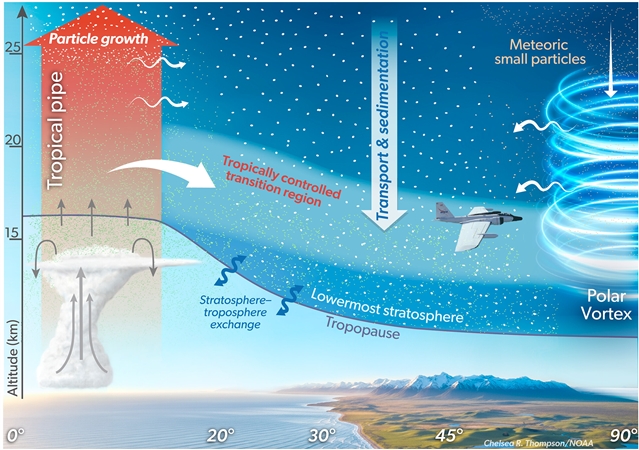
近日,美国科罗拉多大学博尔德分校Ming Lyu团队提出了平流层下方一种未被识别的小颗粒模式。2026年4月23日出版的《科学》杂志发表了这项成果。
对近期现场数据的分析揭示,在19公里以下的平流层,一氧化二氮(N2O)体积比大于270 ppb的区域,存在一种持续性的富含有机物气溶胶粒子模式,其数量几何平均直径约为0.03-0.11微米(表面积几何平均直径为0.08-0.2微米,体积几何平均直径为0.11-0.3微米)。
该模式主要由从对流层输送而来的富含有机物的颗粒组成,难以被卫星及大多数球载光学测量手段有效探测,却在非均相反应的表面积和可冷凝蒸汽的汇中占据主导地位。这些小颗粒在与先前的平流层空气混合时,尺寸增大而浓度降低。现有的全球化学-气候模型未能重现这些颗粒的特征,这表明模型改进对于准确评估拟议中的地球工程方案是必要的。
附:英文原文
Title: An unrecognized mode of small particles in the lower stratosphere
Author: Ming Lyu, Adam T. Ahern, Gregory P. Schill, Michael J. Lawler, Daniel M. Murphy, Samuel J. Taylor, Anthony Fodel, Maya Abou-Ghanem, Colin Gurganus, Yunqian Zhu, Simone Tilmes, Eric Ray, Troy D. Thornberry, Ru-Shan Gao, Eric J. Hintsa, Fred Moore, Geoff Dutton, David Nance, Brad Hall, Andrew W. Rollins, Eleanor M. Waxman, Kristen Zuraski, Glenn S. Diskin, Yonghoon Choi, R. Bradley Pierce, Bernadett Weinzierl, Florian Kuderna, Maximilian Dollner, Eric Jensen, Charles A. Brock
Issue&Volume: 2026-04-23
Abstract: Analysis of recent in situ data reveals a persistent mode of organic-rich aerosol particles in the stratosphere below 19 kilometers at nitrous oxide (N2O) > 270 parts per billion by volume, with a number geometric mean diameter of ~0.03 to 0.11 μm (0.08 to 0.2 μm in surface and 0.11 to 0.3 μm in volume). This mode, composed mostly of organic-rich particles transported from the troposphere, is poorly sensed by satellites and most balloon-borne optical measurements but dominates the surface area for heterogeneous reactions and the sink for condensable vapors. These small particles grow in size and decrease in concentration as they mix with older stratospheric air. A global chemistry-climate model fails to replicate the characteristics of these particles, suggesting that model improvements are necessary for accurate assessment of proposed geoengineering efforts.
DOI: adw8939
Source: https://www.science.org/doi/10.1126/science.adw8939